Posts

Art

Image
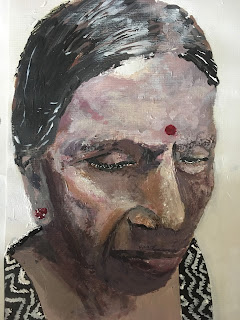
My grandmother is amazing. She is the strongest person I know. Every morning, she walks three miles, taking each step with such an intensity that I’m surprised that the ground doesn’t burst into flame around her. Once, she fell while walking. Had we not by coincidence planned a doctor’s appointment for the next week, we would not have known that she broke her shoulder. She did not complain once. Because of her, art has become an integral part of my life. Not a day goes by when I do not put pen to paper and draw, or imagine how I could mix my paints to capture the colors of the trees or the sky. The painting above is her. She is the one who taught me to paint. She explained that when we force our perceptions on the world, we are blind. She taught me not to look for what I believe, but to see things as they are. For all her self-confidence, she hated having her picture taken, because the skin around her mouth and jaw is darkened as though she has been sunburned, or as if a permanen...

Attempt at UIUC essay

The mind has always excited me. Since I was young, I’ve grappled with concepts such as consciousness, perception, and memory through deep reflection about the way my mind works. But as I grew older, I ran into a problem: thought alone can’t be used to discover truths about the mind. To learn about the mind, we must to create experiments and make measurements. That is why I want to approach the questions of the mind from a different angle: science. Through science, the intricate puzzle of our mind has begun to be pieced together: we have even created machines that can see into our dreams. However, progress is still slow. But what if we could bypass the senses and communicate directly with the brain? Information would be closer than our fingertips: it would be one thought away. The implications of a brain-machine interface reach past even revolutionizing our interactions with machines. We could finally understand human consciousness and perception. I'll admit, my dreams sound li...

On Ethics

We do not tend to question our assumptions. Upon seeing the daytime sky, no one will wonder if it actually is blue. That is the human condition: we must assume the obvious is true, for otherwise our own thoughts force us into indecision. This is the case with nearly any field, but when morality enter the picture, we become even more blind. Ethics, as we usually think about it, is the field that deals with the distinction between right and wrong, and good and bad behavior. However, there are no absolute moral truths, but only desires and aversions that govern our construction of right and wrong, and good and bad. At their core, there are things people want and things that they don’t want, and these desires and aversions drive their decision-making processes. We want life, and we do not want death. We want pleasure, and we do not want pain. We want to take warm showers, we do not want to take cold showers. Whether reasonable or irrational, conscious or subconscious, the vast majority ...

Hand Written

I write this post with pen and paper. Well, I guess that you, future reader, are probably going to be reading this on my blog, so I’ll have to type it up at some point. Oh well.             Anyways, a few weeks ago I decided to keep a journal. My reasoning for this is related to the relationship between our memories and who we are. I’ve heard that we are the sum of our experiences, but most of those experiences somehow lose their way and end up drifting off, like balloons that slip from the hands of some kid. I want to be able to remember this moment thirty years from now, sitting here in this metal desk, writing a blog post with a pen and paper.             So, I decided the best thing to do would be to keep a journal. Well, it is not like this is the first time I have tried. I typed one on the computer for a few days last year. That didn’t last though. The whole point of ...